Countdown to liftoff begins! On Wednesday, NASA will send four astronauts on a historic 10-day trip around the moon and back.
The Artemis II launch is scheduled for around 3:24 p.m. Pacific Standard Time (PST). They’ll be taking flight from Launch Complex 39B at Kennedy Space Center in Florida.
Interested in seeing the launch for yourself? There are a few ways you can watch:
Museum of Flight Watch Party
If you’re interested in watching with other space enthusiasts – you can head on over to the Museum of Flight in Seattle—they’re hosting a watch party! Doors will open at 1:30 p.m. PST. The event is free to attend. You can learn more about the event here.
YouTube
The YouTube coverage begins Wednesday at 7:45 a.m. PST with tanking operations and runs continuously through the entire mission. Click here for the YouTube channel broadcast.
According to NASA, the weather forecast shows an 80% chance of favorable weather conditions for the launch, with cloud coverage and potential for high winds on the ground as primary concerns.
NASA+
NASA has its own free, no-subscription streaming service. This will be a shorter broadcast that begins at 9:50 a.m. PST where you can see the flight crews suit up, liftoff, and eventually sign off after Orion’s solar array wings deploy. Each wing has 15,000 solar cells that convert sunlight into electricity. To watch the NASA+ broadcast, click here.
Why is this flight so historic?
This will be the first crewed mission to orbit the moon in over 50 years. The Artemis II crew includes the first Black man, the first woman and the first Canadian to ever fly on a moon mission.
The flight crew
The crew includes three NASA astronauts and one from the Canadian Space Agency:
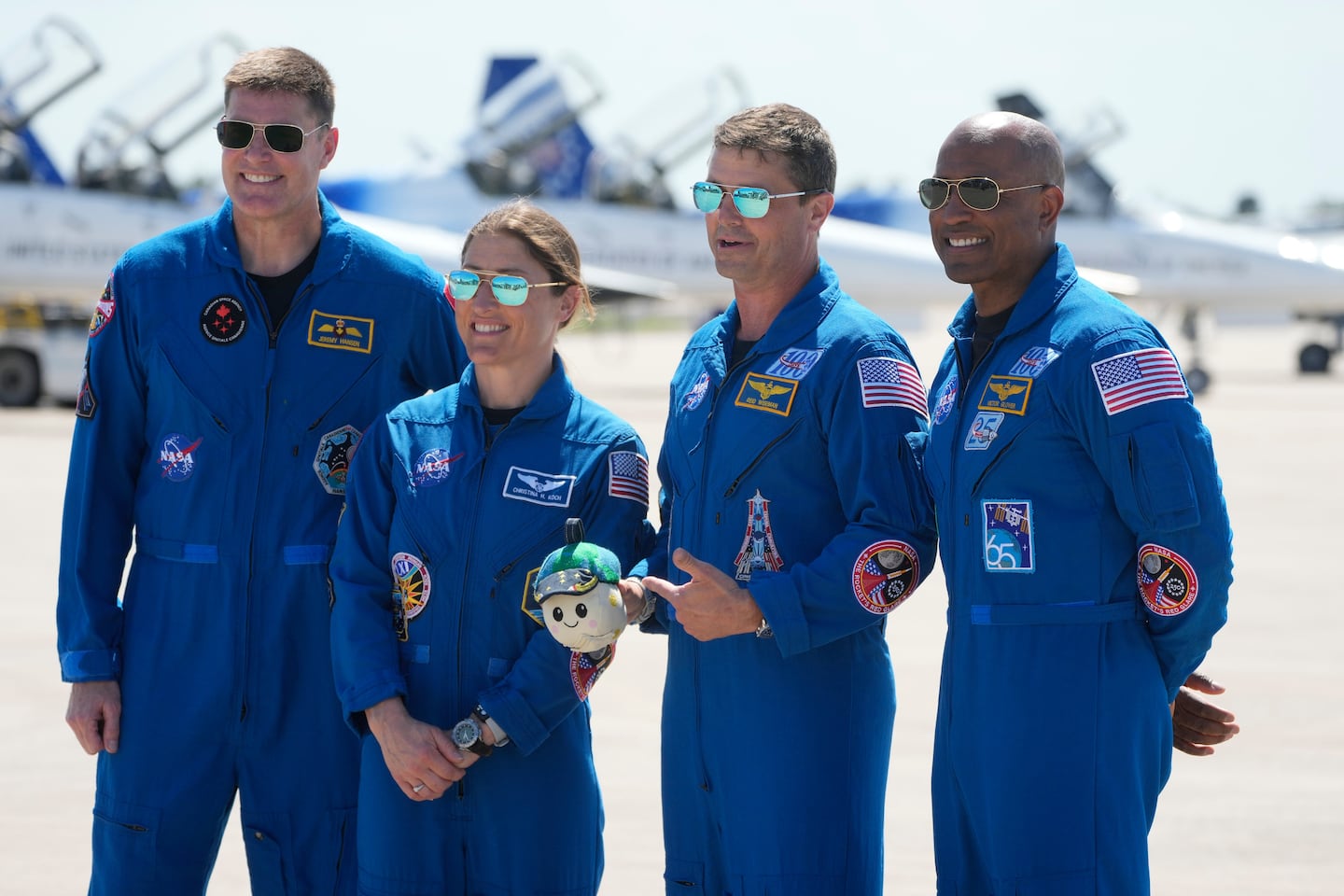
Commander Reid Wiseman – he was selected as a NASA astronaut in 2009. He was born in Baltimore and earned his Bachelor of Science from Rensselaer Polytechnic Institute in Troy, New York and a Master of Science in Systems Engineering from the Johns Hopkins University in Baltimore.
Victor Glover – he is the pilot of the mission. Glover was selected as a NASA astronaut in 2013. He was previously a pilot of the SpaceX Crew-1 mission to the International Space Station for Expedition 64. He’s from California and holds a Bachelor of Science in General Engineering, a Master of Science in Flight Test Engineering, a Master of Science in Systems Engineering and a Master of Military Operational Art and Science.
Christina Koch – she’s the mission specialist for the Artemis II mission. Koch was selected as a NASA astronaut in 2013. She most recently served as a flight engineer on the International Space Station as part of Expeditions 59, 60 and 61. She set a record for the longest single spaceflight by a woman with 328 days.
Jeremy Hansen – He is from the Canadian Space Agency and is also a mission specialist. He spent part of his career with the Royal Canadian Air Cadet Squadron – which is where his aviation career began. He has a Bachelor of Science in Space Science and a Master of Science in Physics.
The Washington connection to the flight
A lot of technology from our state will help it launch—and equally as important—get the astronauts back home safely.
41 companies had a part to play on this mission, according to Democratic Senator Maria Cantwell’s office. Of those companies, includes L3Harris and Karman Space & Defense.
You can read more about the companies here.
©2026 Cox Media Group