WASHINGTON — Starting Tuesday, we’ll see cooler temperatures and lower snow levels in the Cascades, creating tricky conditions if you plan on travelling over the passes for Thanksgiving this week.
According to the Washington State Department of Transportation (WSDOT), about 30,000 drivers use Snoqualmie pass on a typical day, but during holiday travel, that can bump up to 50,000.
Crews have plows running non-stop when there are snow events at the passes, but that won’t stop every crash.
Here are some tips to practice before you hit the road, and during your drive through the pass:
Prepping your car before you go:
- It’s helpful to get a winter maintenance check-up to make sure that your battery, tires, lights, brakes, heater/defroster are in good working condition for the season ahead.
- Also make sure your oil is at a good level and that you have plenty of windshield Washer fluid in your vehicle.
- Make sure you know pass conditions before you head out
- Have chains in your car, just in case. Studded tires do not meet the chain requirement. Violators of ‘chain up’ notices could face a $500 fine. You can watch a video of how to chain up here.
- Keep an ice scraper, a first aid kit, water/snacks, jumper cables and a phone charger in your car for the winter so you don’t have to think to pack them, in the event of an emergency.
- It’s also helpful to have extra blankets or clothes in case a pass shuts down.
- Keep sand or kitty litter in your trunk in case you get stuck and need traction.
- Fill up your gas tank before heading out so you won’t have to stress if there’s standstill traffic or if a highway closes.
- Check your tires for air pressure and to see if you have approved traction tires. Oftentimes, a ‘Traction Tires Advised’ and ‘Traction Tires Required’ warning are issued before a chain up requirement.
Driving in snow
- Don’t use cruise control.
- Drive for the conditions (slow down!) and leave plenty of space between you and the car in front of you. According to the Washington State Department of Transporation (WSDOT), Transportation, a good portion of the time, passes and roads are closed for crashes and spinouts.
- Slow down near chain-up and removal areas-- there may be people out of their vehicles moving around close to the road.
- If you start to fishtail, do not hard brake. Take your foot off the accelerator and gently steer into the direction the rear of the car is sliding to correct it.
- Have your headlights on.
Snowplow safety:
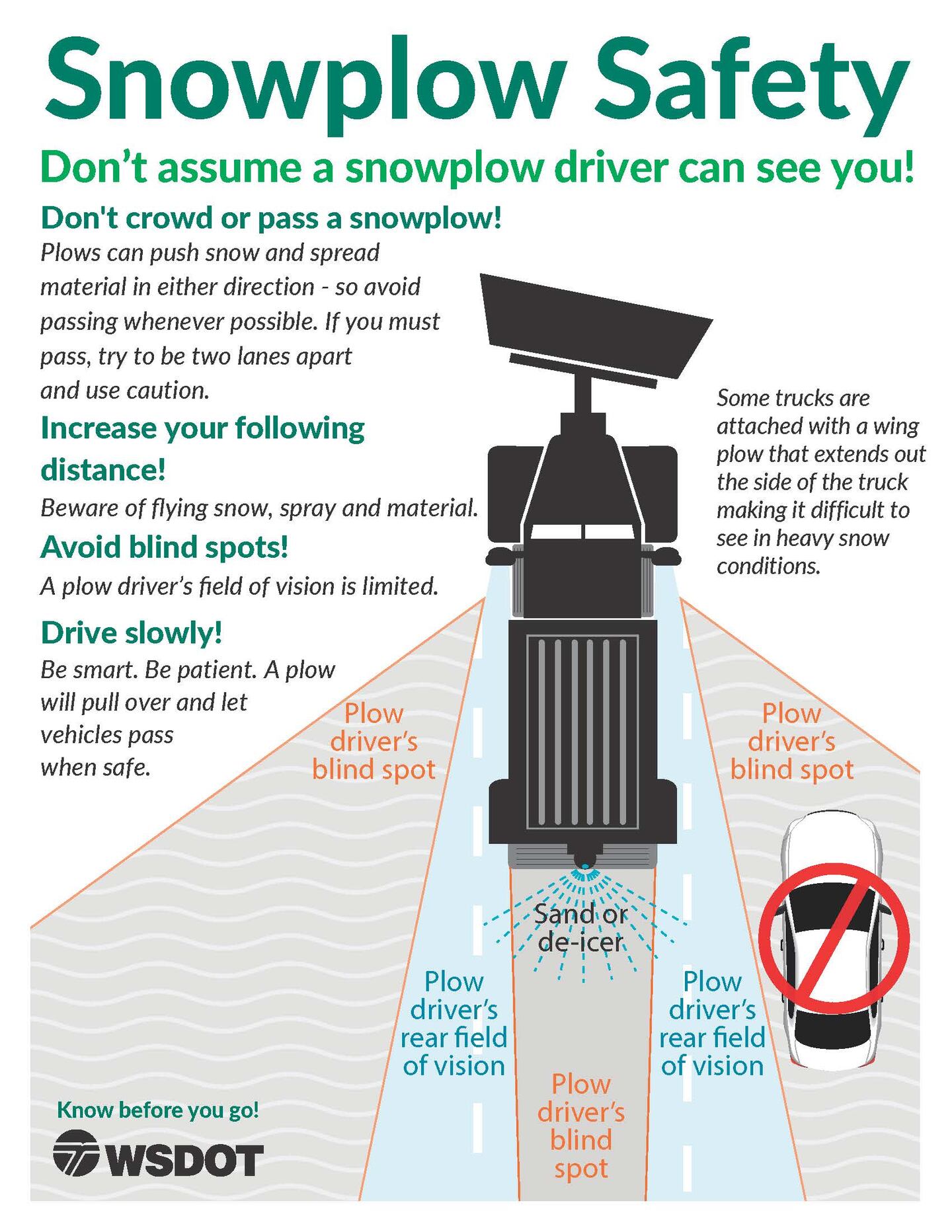
- Don’t assume a snowplow driver can see you! The trucks have three blindspots, and some trucks are attached with a wing plow that extends out to the side of the truck, making it difficult to see in heavy snow.
- WSDOT says avoid passing if you can, but if you need to, try to be two lanes apart and use caution. The plows are pushing snow and spreading material in different directions, so give them a wide berth.
- Increase your following distance- be prepared for flying snow, spray and other road materials.
- Drive slow and be alert.
Best and worst times to travel, specifically Snoqualmie Pass, according to WSDOT:
When TO Travel
Going East (Seattle to Eastern Washington)
- Before 9 AM — Beat the midday traffic surge
- After 6 PM — Once evening congestion clears
Going West (Eastern Washington to Seattle)
- Before 10 AM — Avoid the return rush
- After 6 PM — Traffic lightens up
When NOT to Travel
Heading East (Seattle to Eastern Washington)
- Wednesday, Nov. 26: 11 AM - 4PM — Peak gridlock
- Sunday, Nov. 30: 10AM – 4PM — Busy return rush
Heading West (Eastern Washington to Seattle)
- Saturday, Nov. 29: 11 AM - 4PM — Heavy congestion
- Sunday, Nov.30 : 10 AM - 5PM — Worst time of the weekend
©2025 Cox Media Group