Yayoi Kusama, a Japanese avant-garde artist from the 1960s who re-emerged late in life and found fame through her polka-dot paintings and colorfully mirrored “infinity rooms,” died on Aug. 14. She was 97.
Kusama died at a Tokyo hospital. Her death was announced on Wednesday in a statement on her website, The Washington Post reported. No cause was given.
“She continued to paint until her final days, never setting aside her brush, and continued exploration of forever love and eternal soul,” Yayoi Kusama Studio said in its statement. “We will carry forward Kusama’s wishes and, through art, continue to bring hope and strength for the future to people around the world.”
Kusama rose to prominence in the late 1950s and early 1960s with abstract paintings she called “infinity nets,” The New York Times reported. They consisted of countless small, curving strokes of white paint set against all-white or all-black surfaces, according to the newspaper.
Breaking News: Yayoi Kusama, a Japanese artist whose work caused a stir in the 1960s, while her “Infinity Room” installations drew crowds in recent decades, has died at 97. https://t.co/AsJjORsPgf
— The New York Times (@nytimes) August 27, 2026
The artist later applied that concept to three-dimensional objects, according to the Post. She created “infinity mirror” rooms, reflective spaces that she filled with hundreds of kaleidoscopic LED lights or with silver orbs or polka-dot-covered gourds, the newspaper reported.
Kusama was born on March 22, 1929, in Matsumoto, northwest of Tokyo, and was the youngest of four children, the Times reported.
Over the objections of her parents, in 1948 she enrolled in art school, according to the newspaper. She studied Nihonga painting, a style that merged Japanese and Western traditions.
She broke away from traditional art and began producing semi-abstract paintings that featured floral, astronomical and sexual forms against fields of dots, the Times reported.
“Polka dots are fabulous,” Kusama said in a 2012 interview with The Associated Press, appearing in her orange bob wig and polka dot attire.
Kusama said she was inspired by hallucinatory visions she had experienced since childhood, according to the Post, claiming she could hear the voices of flowers, pumpkins and dogs.
“I don’t consider myself an artist,” she wrote in a 1975 autobiographical essay, “Odyssey of My Struggling Soul.” “I am pursuing art in order to correct the disability which began in my childhood.”
In 1955, three of her paintings were sent to New York and were included in an international watercolor exhibition at the Brooklyn Museum, the Times reported.
Much of Kusama’s work during the 1960s featured a sexually charged blend of humor and provocation, according to the Post.
During her 1968 “Nixon Orgy” in Lower Manhattan, Kusama offered to have sex with President-elect Richard Nixon if he would call for a ceasefire, the newspaper reported.
“Anatomic explosions are better than atomic explosions,” she announced in leaflets distributed on the street.
As the volatile 1960s faded, Kusama returned to Japan in 1973, believing that Americans had lost interest in her work, the Times reported.
During the 1970s, she also began writing fiction and poetry, according to the newspaper. Her busy schedule was not enough to ward off panic attacks, and in 1977 she admitted herself into a mental hospital near Tokyo.
Kusama would make the facility her permanent home and built a studio nearby, the Times reported.
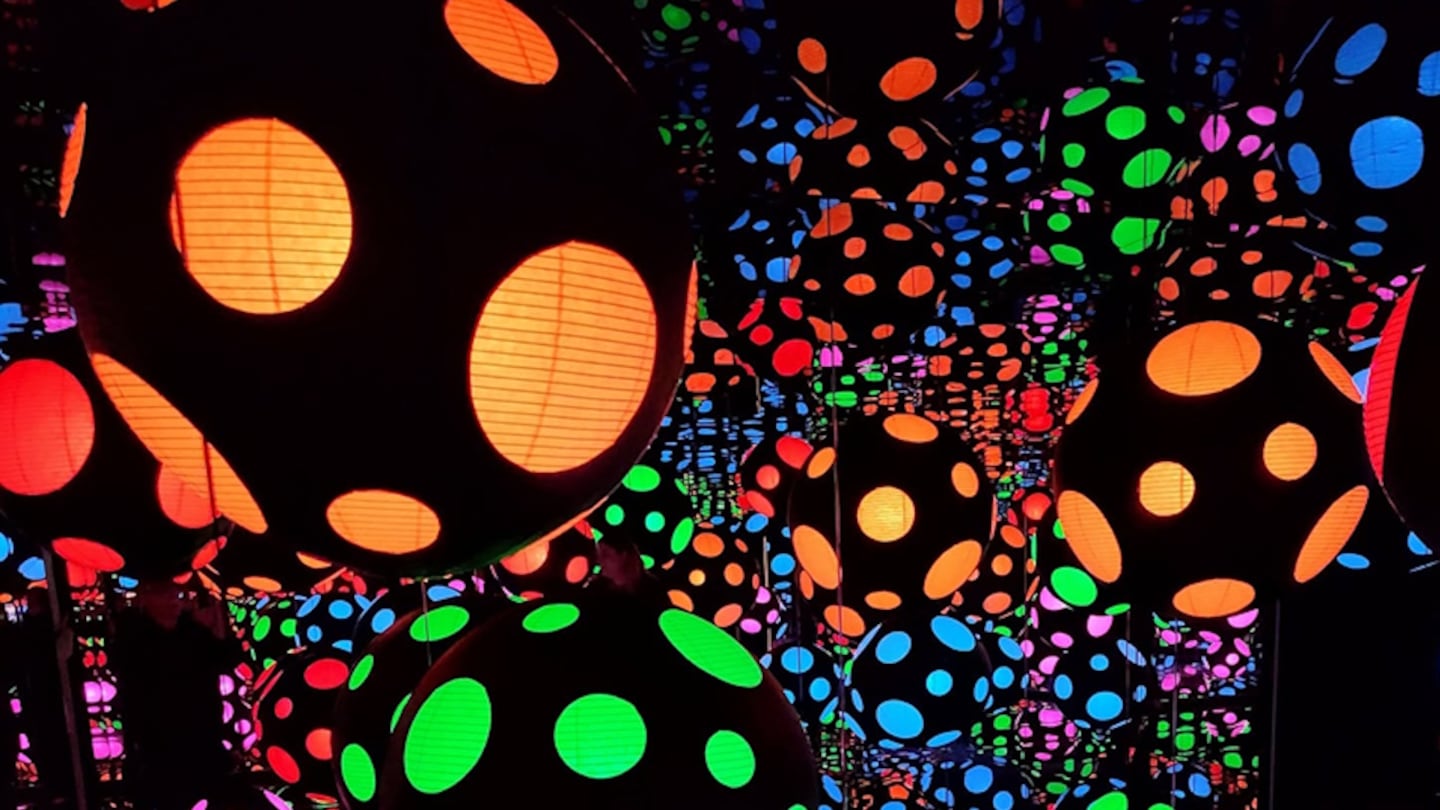
In the late 1990s and early 2000s, Kusama returned to creating rooms covered entirely in polka-dots and mirrored infinity rooms, the Times reported.
With the advent of social media, particularly Instagram, viewers began waiting in line to view Kusama’s creations, according to the Post.
Her exhibitions were presented worldwide, according to the newspaper. That included a residence at the Smithsonian’s Hirshhorn Museum and Sculpture Garden, which showcased six of the rooms in 2017.
“A whole group of visitors came to see the show who wouldn’t ordinarily think of going to a museum,” Chiu told the Post. “When we think of artists having moments, it’s when they kind of transgress or go beyond -- just the art world, and we had all these visitors who didn’t know her name, but they were coming to see her work.”
In 2008, Christie’s auctioned Kusama’s work for $5.8 million, the AP reported. In 2016, she won the Order of Culture, Japan’s highest honor for artists.
©2026 Cox Media Group