OLYMPIA, Wash. — With Washington voters set to decide the fate of the state’s new millionaires tax in next month’s election, business owners, real estate agents, and lawmakers are making competing cases about whether the tax will strengthen or weaken the state’s economy.
Supporters say the tax is needed to help fund education, tax credits for businesses and families, and other public programs. Opponents argue it could drive entrepreneurs, investors, and employers out of Washington.
KIRO 7 spoke with people on both sides of the debate.
At Soak and Sage, a spa in Renton that employs about 20 people, owner Leslie Goeres says the state’s business climate played a role in her decision to expand outside Washington.
The company, which opened in 2024, is preparing to launch a second location in Nashville, Tennessee.
“Our overhead is significantly less,” Goeres said. “Our payroll expense is about 25% less than it is in Seattle.”
She and her family were spending more time in Nashville as she worked on plans for the second spa location there.
“We liked the atmosphere, we liked the restaurants, we liked the bars, we liked the gyms, we liked just the overall vibe of the city,” she said.
Then the millionaires tax became law.
“It was like, okay, this is actually happening,” she said. “We need to make some decisions.”
“Would you say the millionaires tax was sort of like the final straw in making this decision?” reporter Linzi Sheldon asked.
“Yeah, the final straw,” she said. “I think the B&O tax and the FMLA taxes and the overall overhead and the higher sales tax, all of those eat into revenue.”
Some real estate professionals say they are hearing similar concerns from clients.
Nelya Calev, a real estate agent with John L. Scott, told KIRO 7 that some high-income households are already exploring moves out of Washington in response to the tax.
“It’s like, let me call you because nobody wants it to be public,” Calev said.
She pointed to August data from the Northwest Multiple Listing Service for homes priced at $2 million and above.
Calev said the data shows inventory increased 28% from August 2025, closed sales fell 21%, and there were about 10 months of inventory on the market.
“That’s a lot of inventory, and that’s assuming we don’t add any more homes,” Calev said.
Supporters of the tax, like State Senator Manka Dhingra, dispute the idea that it will trigger significant job losses or departures.
“We’re joining 41 other states. We’re not an outlier,” Dhingra, a sponsor of the bill who represents the 45th legislative district on the Eastside, said. “There is always movement that happens.”
When asked whether she is concerned about business owners and job creators leaving Washington, Dhingra said companies have priorities that line up with what Washington can offer.
“They go where a lot of the talent is and where people want to live,” she said.
Dhingra said what people say and what people actually do is often very different and referenced a recent study on customer behavior over rising Netflix and Amazon subscription costs.
“When those monthly subscriptions go up, the members many often are like, well, we’re not going to pay anymore; we’re going to leave,” she said. “But what you see happen over and over again is that people don’t.”
She also argued that Washington’s current tax structure places a disproportionate burden on lower-income residents.
“The bottom line is we cannot continue to have a successful functioning state with one of the most regressive tax policies,” Dhingra said. “That is simply not doable.”
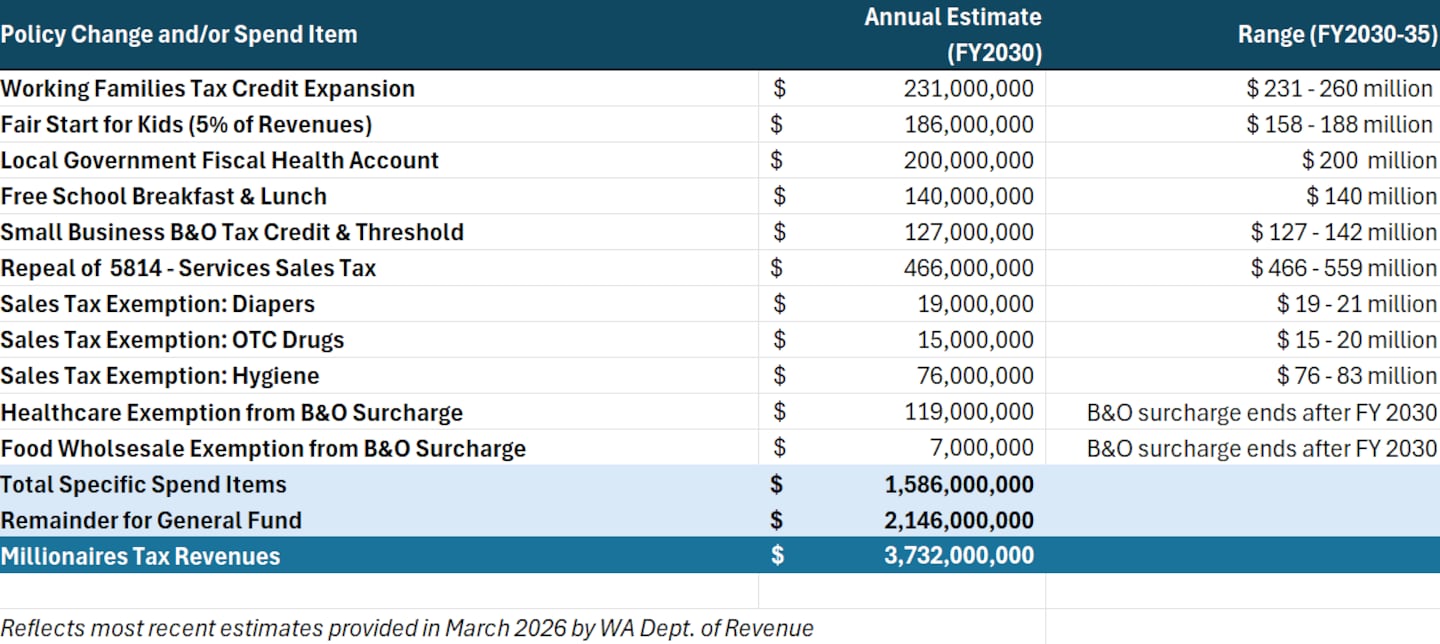
KIRO 7 obtained state projections from the campaign in support of the millionaires tax that show Washington expects to collect about $3.57 billion annually from the tax beginning in 2029. That’s even more than initially projected on the Senate Democrats’ website.
More than half of the revenue, about $2.15 billion, would go to the state’s general fund.
Other projected allocations include, in part:
- $231 million for the Working Families Tax Credit
- $127 million for a small business B&O tax credit
- $200 million for local governments
- $186 million for Fair Start for Kids
- $466 million to replace revenue lost through the repeal of most of Senate Bill 5814 taxes on IT services and live presentations
“Why wasn’t this put to voters first?” reporter Linzi Sheldon asked Dhingra.
“That is what the Legislature’s job is, to make sure that we have a balanced budget, that we are making the tough decisions,” Dhingra said.
The issue now comes down to voters, who will decide on I-645 in November. Voting yes would repeal the tax. Voting no would keep it in place.
KIRO 7 plans to continue its election coverage by speaking with a business owner who supports the tax and believes the state needs the additional revenue.
©2026 Cox Media Group